One Metre Wide, Fully Furnished: A Realistic Patio Plan for Urban Passages
Photo: narrow Victorian side return patio with folding bistro table wall trellis and wheelie bin UK, via p16-seeyou-useast5.capcutcdn-us.com
A Victorian side return is rarely anyone's dream patio. It is the strip beside the house where the wheelie bin lives, where the drainpipe drips, and where you squeeze past with a laundry basket while trying not to clip the recycling box. But that is exactly why it deserves a second look. In a dense city, a metre-wide passage is outdoor space, and outdoor space is precious.
The trick is not to furnish it like a courtyard. Treat it as a working passage first and a seating spot second. Get the clearance right, choose pieces that fold or hug the wall, and make storage earn its footprint. Do that, and the side return stops being a corridor you tolerate and becomes a corner you use.
Measure the pinch points, not the whole strip
Start with a tape measure and a critical eye. The overall width of the passage matters less than its narrowest points: the back door frame, the bin store, the drainpipe, the gate latch, the step down to the garden. Mark those pinch points on the ground with painter's tape. Then walk the route as you actually use it, with a bin bag, a laundry basket and a bag of compost.
A comfortable walking line is usually around 600mm, but a back door needs more room to swing. Check the door's full arc before you place anything nearby. If the passage is also the only route to the garden, keep one clear lane from front to back. Furniture should sit to one side of that lane, not in it.
This is also the moment to be honest about bins. A standard wheelie bin needs elbow room to wheel out, and nobody wants to drag it over a folding chair. Give bins a fixed zone near the gate, and keep furniture beyond it.
Seating that sits close to the wall
Deep armchairs and loungers are the enemy here. Look for benches around 35–45cm deep, backless stools that tuck under a ledge, or slim folding bistro chairs. A wall-mounted fold-down seat can work, but only if the fixings are sound and the wall gets enough sun to dry it after rain. In a shaded side return, anything that traps water will grow moss faster than you can wipe it.
A simple bench is often the best answer. It gives you somewhere to sit while you pull off muddy boots, and it can double as storage if you choose a slim lidded version. Keep cushions indoors when not in use; in a damp passage, they are better treated as bring-out pieces than permanent fixtures.
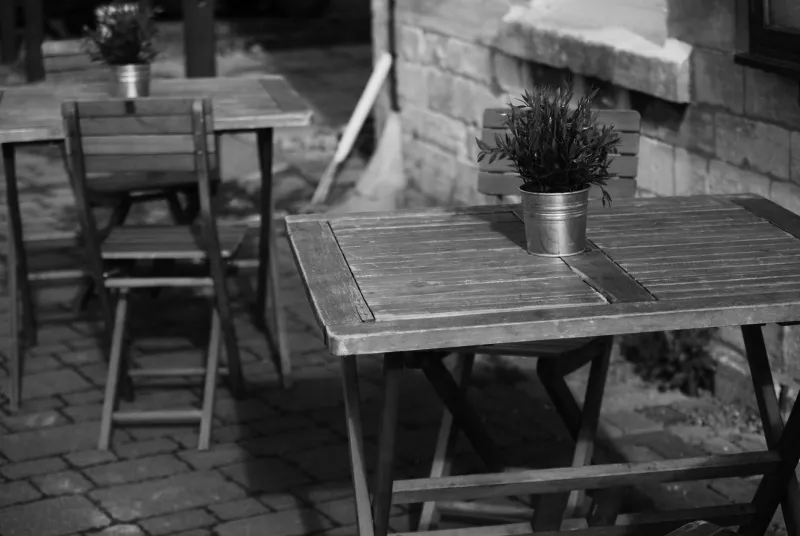
If you want a table, think of it as a occasional surface rather than a permanent dining setup. A narrow drop-leaf table, a wall-leaning folding table, or a console fixed to the wall can all give you a spot for a cup of tea without stealing the walking lane. Wall-leaning tables are especially useful in passages: they store flat against the wall and only come out when needed.
Tables that get out of the way
A wall-leaning table needs a flat, solid surface and fixings suited to brick or masonry. Do not rely on suction cups or cheap hooks in a damp passage. If you are renting, choose a freestanding folding table that can be hung on sturdy hooks when not in use.
Avoid putting a table directly outside the back door. Even a small one will make the doorway feel cramped and will collect whatever you are carrying. Push it down the passage, or place it opposite the door so the swing stays clear.
A narrow ledge or shelf at waist height can be more useful than a table in a tight strip. It holds a mug, a trowel or a candle, and it does not need to be moved when the bin goes out.
Bins, doors and the daily commute
The side return is a route, so protect the route. Keep at least 750mm clear at the back door if you can, and make sure the bin can be wheeled out without lifting it over a planter. If the passage is shared with neighbours, check before you fix anything to the wall or leave furniture in the common route.
A slim vertical store for brooms, bags and recycling boxes can tidy the clutter without eating floor space. Wall hooks are useful for folding chairs, but only if they are rated for the weight and positioned where they will not catch shoulders. Hang things high enough to walk under, or low enough to sit beneath.
Privacy without a hedge of clutter
Side returns often look straight onto a neighbour's window or the street. You do not need a dense wall of screening to soften that. A slatted screen, a trellis with a climber, or a row of tall, narrow planters can create a sense of enclosure without blocking light or swallowing the passage.
Keep the screening vertical and slim. A single climber on a wire frame will do more than a collection of pots. Check that any screen is stable in wind; side returns can funnel gusts between buildings. Fix it securely or choose a freestanding planter with a weighted base.
Storage that does not eat the last metre
Storage is the make-or-break issue. A huge plastic box will dominate a narrow passage and leave no room to move. Instead, use the vertical plane: wall hooks for folding chairs, a slim bench with a lift-up lid, a narrow shelving unit above bin height, or a weatherproof box that fits under the bench.
If you store cushions outdoors, choose a box with a proper seal and raise it off the ground. Better still, bring cushions inside during wet spells. In a British side return, damp is the default, not the exception.
Materials for a damp, shaded strip
Powder-coated aluminium and high-density polyethylene are sensible for frames because they shrug off rain. Teak and acacia can work if they are oiled and allowed to dry, but cheap mild steel will rust. Avoid heavy cast iron in a passage where you need to move things.
Keep the ground clear of leaf litter and check for moss after wet weather. A quick sweep and a scrub now and then will stop the surface turning slippery. If the passage is shady, choose lighter colours; they make the space feel less like a tunnel.
The five-minute layout test
Before you commit, run a simple test. Can you open the back door fully? Can you wheel the bin out without moving furniture? Can you carry a laundry basket through without turning sideways? Can you reach the tap, the gate and the recycling box? If the answer is yes, the layout works.
A narrow urban passage will never be a sprawling patio, and it does not need to be. With shallow seating, a table that folds away, a clear route for bins and back doors, and storage that uses the wall rather than the floor, it becomes something better than a service corridor: a small, useful, genuinely outdoor room.